

Consumers' perceptions of aging are changing. According to a consumer trend report by The New Consumer and Coefficient Capital, more American consumers are not just aiming to live longer but also want to live healthier lives.A 2024 survey by McKinsey shows that in the past year, 70% of consumers in the United States and the United Kingdom (and 85% of consumers in China) purchased more products and services supporting healthy aging and longevity, compared to previous years. Consumers have gained greater control over their health.
Additionally, according to the 2024 Longevity Report by Nutritional Business Journal (NBJ), sales in the healthy aging category have consistently outpaced the overall supplement industry growth since 2022. In 2023, the overall supplement industry grew by 4.4%, while sales in the healthy aging category grew by 5.5%. NBJ forecasts that in 2024, sales of healthy aging supplements (covering various specific health conditions) will surpass $1 billion, and by 2026, will reach $1.04 billion, with a growth rate of 7.7%.
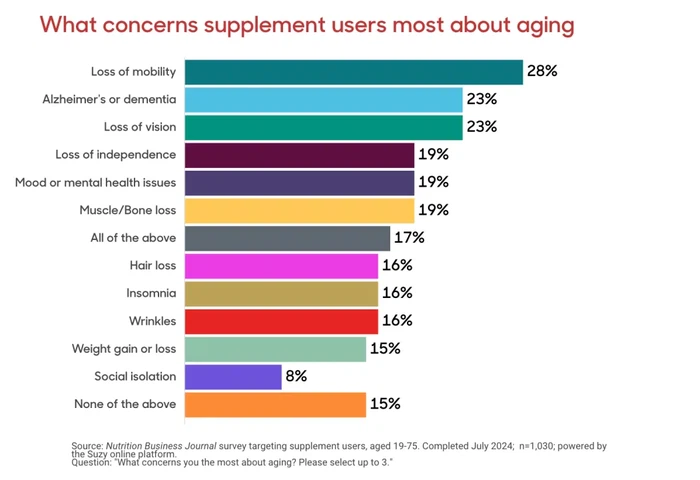
Supplement User Research 2024: The top consumer concerns about aging are: loss of mobility (28%), Alzheimer's or dementia (23%), loss of vision (23%), loss of independence (19%), emotional or mental health issues (19%), muscle/skeletal loss (19%), hair loss (16%), insomnia (16%), and more.
Immunity (35 per cent) is the most common age-related health issue consumers want to address when using supplements. Gut and digestive health (28 per cent), sleep health (23 per cent), hair, skin and nails (22 per cent), muscle and joint health (21 per cent), heart health (19 per cent) and emotional health (19 per cent) are also among the health issues consumers want to address.

5 Key Anti-Aging Ingredients
1.Ergothioneine is a naturally occurring amino acid. In 1909, Charles Tanret isolated a unique sulfur-containing crystalline compound while studying the ergot fungus that affects rye grains, and named it ergothioneine after the fungus. In 1911, Barger and Ewins determined its structure, finding that ergothioneine is a derivative of histidine betaine.
Ergothioneine exists in two tautomeric forms: thiol and thione. The thione form predominates at physiological pH, which gives ergothioneine its exceptionally strong antioxidant properties. According to data from Huaxi Biotech, the DPPH free radical scavenging ability of Bioyouth™-EGT ergothioneine is 14 times greater than that of glutathione at the same concentration, and 30 times greater than Coenzyme Q10, making it a true powerhouse in antioxidants.
Ergothioneine can target organs to combat aging, offering health benefits for the skin, eyes, brain, cardiovascular system, liver, and more.
2.Spermidine is a biogenic amine in the family of polyamines, which are polycations that interact with negatively charged molecules, including DNA, RNA and lipids. Spermidine is produced from its precursor putrescine by different metabolic reactions.
Spermidine is commonly found in different organisms, including bacteria, fungi, plants and animals, and is heat resistant. Whole grains, vegetables and legumes are the most common food groups containing the highest levels of spermidine, with wheat germ containing 0.35 mg/g, soybeans containing 0.070-0.180 mg/g, apricot mushrooms containing 0.060-0.160 mg/g and pine nuts containing 0.060 mg/g.
3.PQQ is an aromatic water-soluble quinone first reported by Hauge et al. in 1964. It is another coenzyme of glucose dehydrogenase (GDH), distinct from flavin adenine dinucleotide (FAD) and nicotinamide adenine dinucleotide (NADH).
PQQ is a novel biofactor involved in regulating the redox processes in the mitochondrial respiratory chain. It neutralizes superoxide and hydroxyl free radicals that lead to mitochondrial dysfunction and can counteract cellular damage caused by various types of oxidative stress, including reoxygenation injury in the heart, chronic heart failure, ethanol-induced liver damage, and hypoxia-induced cognitive deficits. PQQ not only protects mitochondria from oxidative stress but also promotes mitochondrial biogenesis. It stimulates new mitochondrial growth in cells by increasing peroxisome proliferator-activated receptor gamma coactivator 1-alpha (PGC-1α) and activating transcription networks.
PQQ can effectively prevent neurodegenerative changes caused by oxidative stress. Additionally, it can enhance the production of nerve growth factor (NGF). In rodent models of stroke and brain injury, PQQ has been shown to resist cognitive decline. In human clinical trials, PQQ can promote cognitive function in the elderly and improve regional blood flow.

4.Phosphatidylserine (PS) is an anionic phospholipid found in the membranes of eukaryotic cells, constituting 5-10% of the total cellular lipids. PS is composed of a glycerol backbone, which is esterified at the sn-1 and sn-2 carbons with two fatty acyl chains of different lengths and saturation levels, and a phosphate group is attached at the sn-3 position. Compared to phosphatidylcholine (PC) and phosphatidylethanolamine (PE), a notable feature of PS is the covalent linkage between serine and the phosphate group, which gives the PS headgroup a net negative charge.
5.Urolithin A (UA) is a natural polyphenolic compound and a metabolite of ellagitannins (ETs), discovered and officially named by Begoña Cerdá in 2005. ETs, as the metabolic precursors of UA, are primarily found in natural foods and medicinal plants such as pomegranates, strawberries, walnuts, and raspberries.
In 2016, researchers at the University of Washington published a study in Nature Medicine showing that urolithin A can promote mitophagy, extending the lifespan of Caenorhabditis elegans by 45%. It became the first natural compound scientifically recognized for its ability to promote mitophagy. In 2019, the first human clinical trial of urolithin A demonstrated its anti-aging effects, significantly increasing whole-body fatty acid oxidation levels, an important indicator of mitochondrial function.
Reference: https://www.cell.com/trends/molecular-medicine/fulltext/S1471-4914(21)00118-0#gr2